
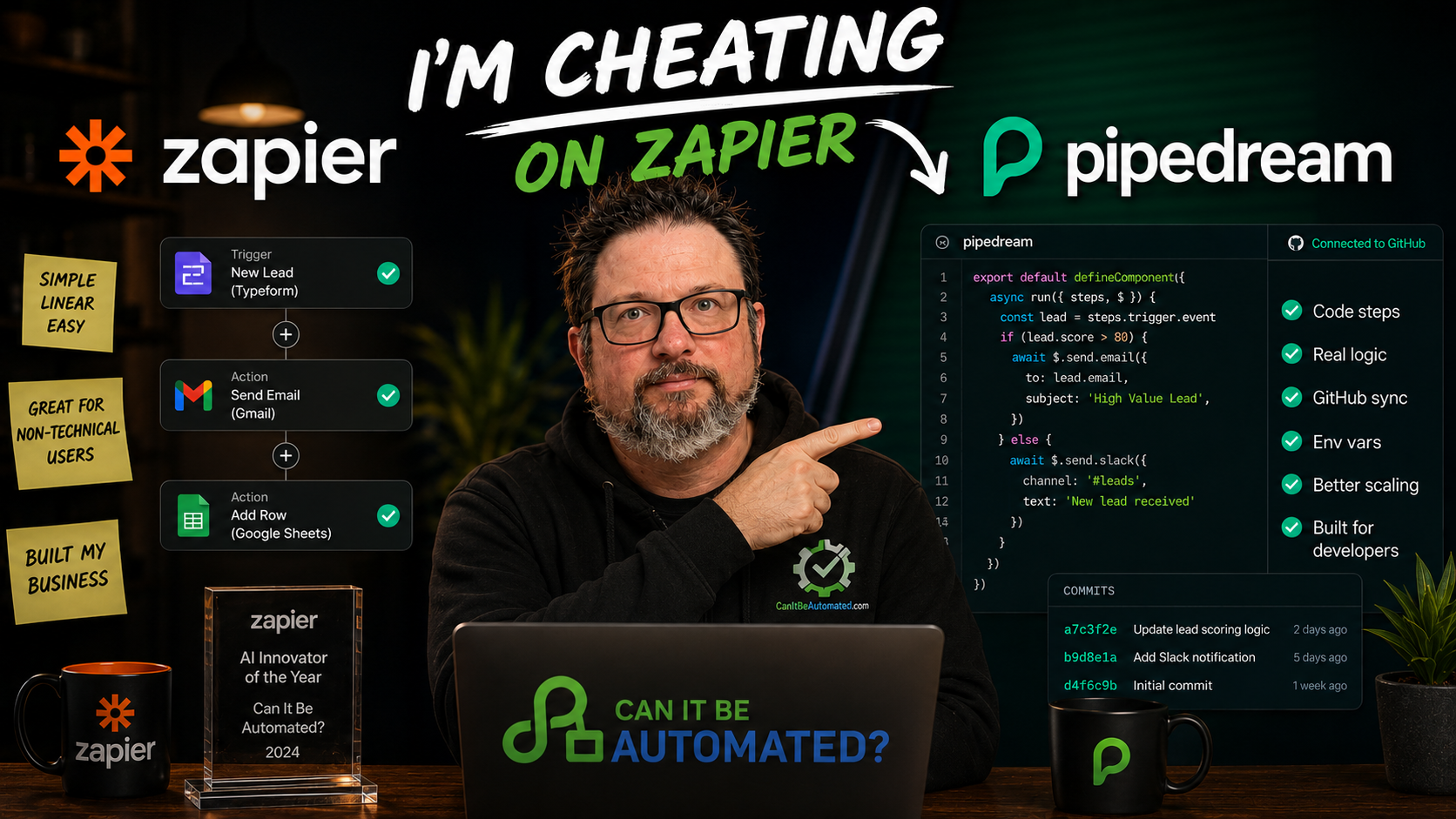
Zapier vs Pipedream? Its a long story.
Zapier built my business.
I say that without any hesitation. When I started Can It Be Automated, Zapier was the tool that let me say yes to almost any workflow a client threw at me. It’s the reason I was named Zapier’s AI Innovator of the Year. I’ve built hundreds of Zaps, trained clients on it, and defended it in more sales calls than I can count. None of what I’m about to say erases that.
But over the last year, something has shifted. As I’ve leaned harder into building with Claude and taken on more complex, code-adjacent workflows, I’ve found myself reaching for Pipedream more and more, and reaching for Zapier less. This post is about why.
The work got more complex
Early on, most of what I automated was linear: trigger, a couple of steps, done. Zapier is genuinely great at that. But client work has evolved. I’m now building multi-branch logic, AI agent workflows, and integrations that need real conditional handling, not just filters bolted onto a Zap. Zapier can technically do a lot of this, but it starts to feel like forcing a square peg into a round hole. Pipedream lets me drop into actual code steps when the visual builder isn’t enough, without leaving the platform or standing up separate infrastructure.
Cost stops being an afterthought
Zapier’s task-based pricing works fine until a workflow scales or a client’s data volume grows. I’ve had to spend real time optimizing Zaps just to keep a client under their task limit, which is time I’d rather spend building. Pipedream’s pricing model has made that kind of defensive optimization far less necessary, which matters a lot when you’re running an agency and margin is the whole game.
GitHub integration changes how I build
This is the one that surprised me most. Being able to connect workflows to a GitHub repo means version control, proper history, and the ability to actually review what changed and when. For someone who doesn’t write code by hand and leans on Claude to generate and edit it, having that paper trail is not a nice-to-have, it’s how I catch mistakes before they hit a client’s live system.
Environment variables, done right
This is a small thing that turned out to be a big thing. Pipedream lets me store environment variables globally across my account and also scope them per project. Zapier doesn’t give you that same flexibility. When you’re managing API keys and credentials across a dozen client accounts, that distinction is the difference between a clean, auditable setup and a mess of duplicated secrets scattered across individual Zaps.
I’m not breaking up with Zapier
To be clear, I’m not ripping Zapier out of every client stack. It’s still the right call for simpler, low-complexity automations, especially for clients who need to see and edit their own workflows without touching code. Zapier’s ecosystem, app coverage, and ease of use for non-technical users are still hard to beat.
What’s changed is my default. For anything with real complexity, AI in the loop, or a need for tighter engineering discipline, Pipedream is now where I start. A year ago that would not have been true.
Tools change. What matters is building the right thing for the client in front of you, not staying loyal to the tool that got you here. Zapier got Can It Be Automated off the ground. Pipedream is where a lot of the next chapter is getting built.

Leave A Comment