
If you’ve spent any time on social media lately, you’ve probably seen some version of this claim:
One AI-generated image uses 10 gallons of water.
It sounds pretty awful.
The problem is that the number doesn’t hold up very well when you look at where it came from and what was actually measured.
That doesn’t mean AI has no environmental impact. It does. AI systems run in data centers that use electricity, generate heat and, in some cases, use water as part of their cooling systems.
But there’s a big difference between saying AI uses water and saying every AI image uses 10 gallons of water.
One is a reasonable statement about the technology. The other is a catchy statistic that needs a lot more explanation.
There is another important piece of this discussion that often gets left out entirely:
When we say water is “used” or “consumed,” we aren’t saying that the water has disappeared from the planet.
That distinction is important.
So let’s look at what the numbers actually tell us.
Where Does AI Use Water?
AI doesn’t use water directly when you type a prompt.
The water is primarily associated with the infrastructure running the computers that process the request.
Large data centers contain thousands of processors. Those processors generate a lot of heat, especially when they’re running the demanding calculations required by modern AI models.
That heat has to be removed.
Some data centers use cooling towers and evaporative cooling, where water helps remove heat from the facility. Other facilities use different approaches, including air cooling and newer closed-loop liquid cooling systems.
This is where the idea of AI having a “water footprint” comes from.
But we need to be careful with the terminology.
What Does It Actually Mean to “Consume” Water?
Here’s something that gets lost in almost every viral discussion about AI and water:
Water isn’t destroyed when we use it.
Earth isn’t running out of water because someone generated an AI image.
The water cycle continues.
Water evaporates. It forms clouds. It falls as rain or snow. It flows into rivers and lakes. It replenishes groundwater. Eventually, it can be used again.
The total amount of water on Earth isn’t disappearing.
So why do researchers talk about “water consumption”?
Because location and timing matter.
Imagine a data center in a dry region takes freshwater from a local river or municipal water system and uses evaporative cooling.
Some of that water becomes water vapor and enters the atmosphere.
Eventually, that water will come back down as precipitation.
But it may not come back:
- In the same location
- In the same watershed
- During the same season
- At a time when the local community needs it
The water hasn’t been destroyed.
It has been moved through the water cycle.
From the perspective of a local watershed, however, that water may no longer be available for immediate use.
That’s why the term “consumptive water use” is used in water-resource research.
The U.S. Geological Survey distinguishes between water that is withdrawn and water that is actually consumed. Water that is returned to the local environment can remain available for other uses, while water that evaporates or otherwise leaves the immediate water system can be considered consumptive use.
This distinction is extremely important when talking about AI.
Water Isn’t Necessarily “Lost”
Suppose a data center withdraws one million gallons of water for cooling.
It would be misleading to simply say:
“The data center used up one million gallons of water.”
Some of that water may be circulated through the cooling system repeatedly.
Some may be discharged back into the environment.
Some may go through wastewater treatment.
Some may return to groundwater or surface water.
And some may evaporate into the atmosphere.
The amount that is actually consumed depends on the cooling technology and the facility’s operating practices.
The U.S. Geological Survey refers to water returned to surface water or groundwater as return flow, and notes that a substantial portion of water withdrawn for human use can ultimately return to the environment.
For evaporative cooling, however, evaporation is one of the primary sources of water consumption, along with smaller losses such as blowdown and drift.
So when you see a number describing the “water footprint” of AI, it’s important to ask what that number actually represents.
Is it:
Water withdrawn?
Water consumed?
Water that evaporated?
Water used indirectly to generate electricity?
Those aren’t necessarily the same thing.
Why Location Matters So Much
This leads to one of the most important points in the entire conversation.
A gallon of water doesn’t have the same environmental significance everywhere.
Imagine two data centers.
Data Center A is located in an area with abundant rainfall, plentiful water supplies and a cooling system that returns most of its water to the local system.
Data Center B is located in an extremely dry region that is experiencing a prolonged drought and relies heavily on freshwater for evaporative cooling.
The same amount of water consumption could have very different consequences in those two locations.
That means the question shouldn’t simply be:
“How much water does AI use?”
A better question is:
“How much freshwater is this particular facility consuming, where is it coming from, and what does that mean for the surrounding watershed?”
That’s a much more useful way to think about the issue.
Where Did the 10-Gallon Number Come From?
This is where things get interesting.
The widely shared claim that one AI image uses 10 gallons of water doesn’t appear to come from a study that actually measured 10 gallons of water being consumed for every image generated.
An analysis by Understanding Your AI looked into the claim and estimated that an AI-generated image could be closer to 15 to 60 milliliters of water.
That’s roughly one to four tablespoons.
It is still an estimate. It isn’t a measurement taken from a specific image-generation request.
But it is a very different number from 10 gallons.
And that’s really the point.
If we’re going to talk about the environmental cost of AI, we should use numbers that reflect what the research actually supports.
Text Prompts Are Even Smaller
The numbers for ordinary text-based AI use are smaller still.
One estimate cited by Understanding Your AI puts a typical ChatGPT text prompt at approximately 0.3 milliliters of water.
That’s less than a single milliliter.
Other research has produced higher estimates, which is one reason it’s important not to treat 0.3 milliliters as a universal number for every ChatGPT request.
AI models aren’t all the same.
Neither are data centers.
The result depends on the model, the hardware, the complexity of the request, the cooling system, the local climate and the methodology used to calculate the number.
Still, even allowing for substantial variation, the available estimates are nowhere close to the idea that every interaction with an AI system consumes gallons of water.
Here’s Where the Comparison Gets Interesting
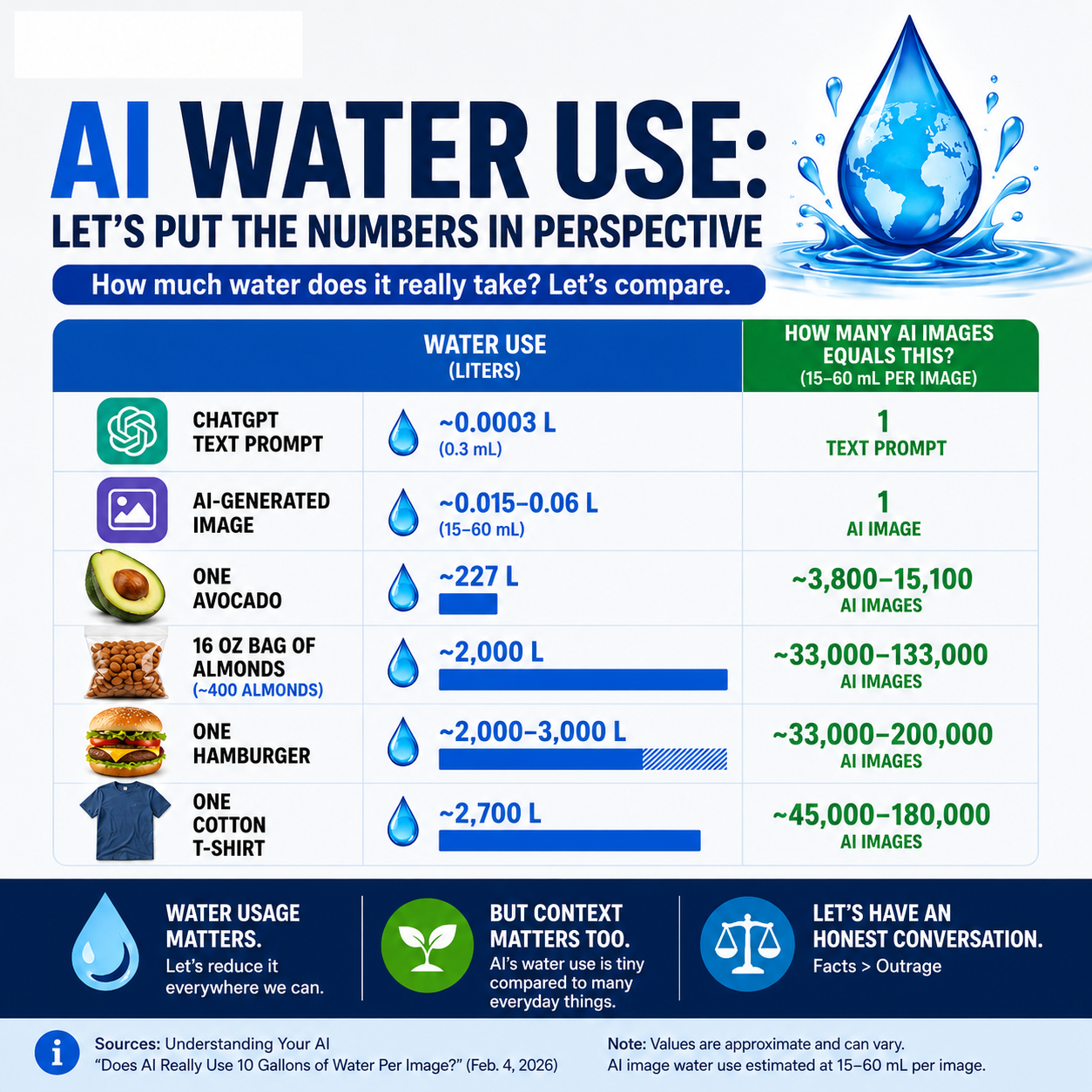
The easiest way to understand these numbers is to put them next to things we already use and consume.
According to the figures compiled by Understanding Your AI, the approximate water footprints include:
| Item | Approximate water use |
|---|---|
| ChatGPT text prompt | ~0.3 mL |
| AI-generated image | ~15 to 60 mL |
| One avocado | ~227 liters |
| One hamburger | ~2,000 to 3,000 liters |
| One cotton T-shirt | ~2,700 liters |
| One almond | ~5 liters |
These numbers come from different types of estimates, so they shouldn’t be treated as perfectly precise measurements.
They’re useful mainly for understanding the relative scale.
And the scale is pretty surprising.
What About a Bag of Almonds?
This is probably the comparison that caught my attention the most.
A typical 16-ounce bag of almonds contains roughly 400 almonds, depending on their size.
If we use the commonly cited estimate of about 5 liters of water per almond, that gives us approximately:
2,000 liters of water.
That’s about 528 gallons.
Now compare that with the estimated 15 to 60 milliliters of water associated with an AI-generated image.
A 16-ounce bag of almonds would be roughly equivalent to:
33,000 to 133,000 AI-generated images.
That’s not an argument against eating almonds.
It’s an argument for putting numbers in context.
What About a Hamburger?
The estimated water footprint of a hamburger is even larger.
Using the figures above, one hamburger represents approximately 2,000 to 3,000 liters of water.
At 15 to 60 milliliters per AI-generated image, that’s roughly:
33,000 to 200,000 AI-generated images.
Again, this isn’t saying that hamburgers are bad and AI is good.
It’s simply showing how easy it is to make something sound enormous when you don’t compare it with anything else.
And Then There’s the Cotton T-Shirt
The estimated water footprint of a cotton T-shirt is around 2,700 liters.
That’s roughly:
45,000 to 180,000 AI-generated images.
Most of us don’t think twice about buying a new shirt.
We probably don’t think about its water footprint when we put it in the shopping cart.
Yet an AI image can suddenly become an environmental crisis because somebody posts a graphic claiming it consumed 10 gallons of water.
That’s where context matters.
Does That Mean AI Isn’t an Environmental Problem?
No.
Not at all.
This is where the conversation often gets unnecessarily polarized.
AI has a real environmental footprint.
Data centers consume enormous amounts of electricity. They require sophisticated cooling systems. Building the hardware requires raw materials and manufacturing. Training large models can require significant amounts of computing power.
And when AI is used billions of times, even a very small impact per request can add up.
That’s worth paying attention to.
But there’s a difference between taking a problem seriously and exaggerating it.
The answer isn’t to pretend AI has no environmental cost.
The answer is to figure out exactly what that cost is and find ways to reduce it.
Training Isn’t the Same as Using AI
Another source of confusion is the difference between training an AI model and using one.
Training is the process of creating the model. It can require enormous amounts of computing power over long periods of time.
Using the model after it has been trained is called inference.
When you ask ChatGPT a question, you’re using the model, not retraining it from scratch.
The water and energy requirements can be very different.
A 2023 research paper from researchers at the University of California, Riverside, looked at the water footprint associated with AI systems and estimated that training GPT-3 in Microsoft’s U.S. data centers could directly evaporate approximately 700,000 liters of freshwater.
That’s a substantial amount.
But it doesn’t mean that every person who subsequently asks the model a question is responsible for another 700,000 liters.
Those are two very different workloads.
Data Centers Are Changing
There’s also a part of this story that gets surprisingly little attention.
Data center technology is improving.
Microsoft announced a newer generation of data centers designed specifically for AI workloads that uses a closed-loop cooling system and does not require water for cooling operations.
Microsoft estimates that the design can avoid more than 125 million liters of water consumption per year per data center compared with evaporative cooling.
That’s a pretty big deal.
AI is increasing the demand for computing infrastructure, but that demand is also pushing engineers to solve some very difficult problems around heat, electricity and water.
Better cooling technology is one of those solutions.
The same thing has happened in other industries for decades. When a technology becomes more important, we generally get better at making it more efficient.
There’s no reason to assume AI will be different.
Small Numbers Can Still Become Big Numbers
There is one legitimate criticism that shouldn’t be dismissed.
Even if one AI request uses a tiny amount of water, AI is being used at an enormous scale.
A billion small things can add up to something very large.
That’s why the environmental discussion shouldn’t focus entirely on whether one image uses 15 milliliters or 60 milliliters.
The bigger questions are:
How many requests are being processed?
How much water is the industry using overall?
Where is that water coming from?
Are data centers being built in areas that are already experiencing water shortages?
How much can new cooling technology reduce consumption?
And are AI companies being transparent about the numbers?
Those are much better questions than whether an individual image supposedly costs 10 gallons.
This Is Where Smart Government Regulation Makes Sense
There is another part of this conversation that shouldn’t be overlooked.
Government has a role in making sure AI infrastructure grows responsibly.
That doesn’t necessarily mean banning data centers or putting arbitrary limits on AI.
In fact, regulations based on a viral statistic like “one AI image uses 10 gallons of water” would be a pretty bad way to approach the problem.
Good regulation should be based on actual measurements and local conditions.
For example, governments could require large data centers to disclose:
- How much water they withdraw
- How much water they actually consume
- Where that water comes from
- How much is returned to the local water system
- What cooling technology they use
- What they are doing to reduce consumption
That information would give communities a much better picture of the actual impact before approving major new facilities.
Regulators could also establish stricter requirements for new data centers being built in areas that are already experiencing significant water shortages.
There are places where adding another major industrial water user may not make sense.
There are also places where it may make perfect sense, particularly if the facility uses closed-loop or water-free cooling and has access to reliable power and adequate infrastructure.
That distinction matters.
Government can also encourage companies to adopt better technology rather than simply punishing them for using older technology.
Tax incentives, permitting advantages or other incentives for water-efficient cooling systems could accelerate the adoption of technologies that dramatically reduce freshwater consumption.
And there should be consequences when companies make unreasonable demands on local resources.
The goal shouldn’t be:
“Stop AI.”
It should be:
“Build AI infrastructure responsibly.”
That means smart permitting, transparent reporting, water-use standards, environmental reviews and incentives for better technology.
It also means avoiding regulations that treat every data center, every AI model and every community as though they have the same environmental circumstances.
A data center using millions of gallons of potable water in a drought-stricken region should probably face a very different regulatory environment from one using a closed-loop cooling system that consumes virtually no water for cooling.
That’s not anti-business.
It’s simply good planning.
We’ve done this with other industries for decades. We regulate pollution, industrial water use, emissions, building standards and energy efficiency because the cost of economic activity shouldn’t simply be pushed onto everyone else.
AI shouldn’t get a free pass.
But it also shouldn’t be singled out for arbitrary restrictions based on exaggerated social-media statistics.
Measure the impact. Publish the data. Set reasonable standards. Reward better technology. Penalize irresponsible use of scarce resources.
That’s what smart regulation looks like.
AI’s Water Usage Is Worth Watching
At Can It Be Automated, we’re obviously interested in AI.
We spend our time helping businesses figure out where AI and automation can actually make a difference.
That doesn’t mean we think every use of AI is automatically good.
Technology comes with tradeoffs.
AI has costs, just like every other technology we’ve adopted.
The right response is to understand those costs and work on reducing them.
That means more efficient models.
More efficient hardware.
Better cooling systems.
Better data center design.
Better use of renewable and lower-impact energy sources.
And better reporting from the companies building all of this infrastructure.
We Should Be Able to Have a Reasonable Conversation About AI
I don’t think we need to choose between two extremes.
We don’t have to pretend AI is destroying the planet.
And we don’t have to pretend AI has no environmental consequences.
Both positions miss the bigger picture.
The more useful approach is to look at the actual data.
An AI-generated image appears to use far less water than the viral “10 gallons” claim suggests.
A text prompt appears to use considerably less still.
At the same time, AI infrastructure consumes significant resources when you look at the entire industry and the enormous scale at which these systems operate.
Both of those things can be true.
And the same principle applies to water itself.
When we say a certain amount of water is “consumed,” we’re not saying that water has ceased to exist.
We’re saying that the water has moved out of the local system and may not be immediately available to that community or ecosystem.
That is a real issue, particularly in areas where water is scarce.
But it is a very different issue from “AI is making the world’s water disappear.”
Understanding that difference makes the conversation much more productive.
The Bottom Line
The next time you see a post claiming that an AI image uses 10 gallons of water, don’t automatically believe it.
Look at the source.
Look at the methodology.
Look at whether the number refers to training or inference.
Look at whether it includes direct water consumption, indirect water consumption or both.
And most importantly, look at the scale.
The current estimates discussed by Understanding Your AI put AI image generation somewhere around 15 to 60 milliliters per image, rather than 10 gallons.
That’s still a resource cost.
But it’s a dramatically different conversation.
A 16-ounce bag of almonds can represent roughly 2,000 liters of water based on the estimates discussed above.
A hamburger can represent thousands of liters.
A cotton T-shirt can represent thousands of liters.
None of those comparisons mean we should stop eating hamburgers, stop buying clothes or stop eating almonds.
They simply remind us that AI isn’t operating in a vacuum.
Everything we consume has a resource footprint.
And water isn’t being destroyed when we use it. It is moving through a cycle that has been operating for billions of years.
The question is whether we’re using freshwater in a way that makes sense for the people, communities and ecosystems that depend on it here and now.
That’s why smart regulation matters.
That’s why better cooling technology matters.
And that’s why accurate data matters.
If we’re going to criticize AI for its environmental impact, that’s fair.
But let’s use the same standard we should use for everything else.
Get the numbers right. Put them in context. Then figure out what we can do better.
That’s a much more useful conversation.
Primary sources
- Understanding Your AI — “Does AI Really Use 10 Gallons of Water Per Image?”
Read the Understanding Your AI analysis - University of California / Communications of the ACM — “Making AI Less ‘Thirsty’”
This is the major academic source behind the AI water-footprint discussion.
Read the published article - arXiv — full research paper, “Making AI Less ‘Thirsty’: Uncovering and Addressing the Secret Water Footprint of AI Models”
Read the research paper
Water-use definitions and the “water isn’t destroyed” point
- U.S. Geological Survey — Water-Use Terminology
This is the source I’d use to support the article’s explanation of withdrawal, consumptive use, return flow, and closed-loop cooling.
USGS Water-Use Terminology - U.S. Geological Survey — Water Use in the United States
Particularly useful because it explicitly says “Not all water withdrawn for human use is lost, much of it returns to the environment.”
USGS Water Use in the United States
Data-center cooling
- Microsoft — Zero Water for Cooling
Microsoft says its newer AI-optimized data-center design uses chip-level cooling and avoids more than 125 million liters of water per year per data center for cooling.
Microsoft Data Center Innovation Room — Zero Water for Cooling
Can It Be Automated (CIBA) helps businesses identify practical opportunities to use AI and automation to reduce repetitive work, improve efficiency and give their teams more time to focus on higher-value work.
The goal isn’t to automate everything. It’s to automate the right things.

Leave A Comment